
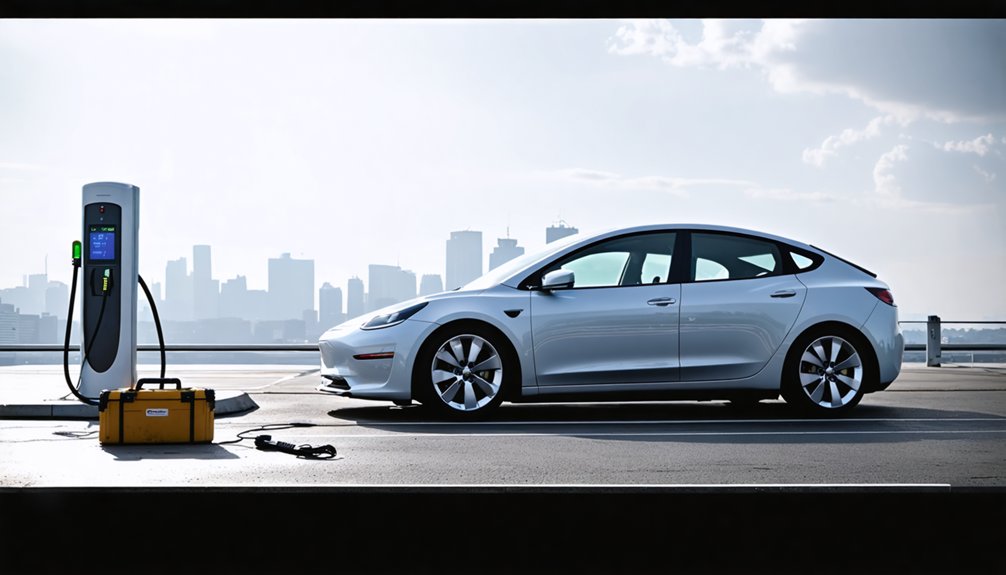

A used EV should be evaluated for price versus new, model depreciation, battery health, warranty status, lease‑return mileage, and documentation. Average used EV prices fell to $37,000 in late 2024 and are now often under $25,000, with depreciation around 15 % per year and 40‑50 % below sticker price for low‑mileage units. Verify State‑of‑Health (SoH > 80 %) and remaining warranty, check clean title, VIN match, and service history, and compare real‑world range under HVAC load. Understanding market trends, inventory data, and incentives will reveal the true value and negotiating leverage.
Key Takeaways
- Check the battery’s state of health (SoH) and warranty transferability; aim for SoH ≥ 80 % and remaining coverage.
- Verify mileage and lease‑return age; low‑mileage (≤ 20,000 mi) 24‑36‑month returns offer the best value.
- Compare the vehicle’s actual range and charging speed to EPA estimates, especially under HVAC load.
- Assess market price trends: used EVs average $37k, with many under $25k; negotiate using depreciation data (≈ 15 %/yr).
- Inspect condition thoroughly—photos of dashboard, odometer, and diagnostics, plus service records—to support price negotiations.
How Much a Used EV Really Costs Compared to a New One
Comparing the price of a pre‑owned electric vehicle to a brand‑new model reveals a substantial discount across most segments.
In late 2024 the average used EV cost about $37,000, and by 2026 it fell further, with nearly 40 % of listings under $25,000.
Compact sedans such as the Chevy Bolt EUV or Nissan Leaf now trade between $17,000 and $23,000, a figure that undercuts comparable gasoline models by $1,000–$2,000.
Depreciation is rapid: EVs lose roughly 15 % annually, and those with under 30,000 miles sell for 40–50 % below original sticker price.
The purchase premium for a new EV is consequently mitigated by a favorable resale outlook, especially as off‑lease inventory floods the market, driving prices toward $20,000 by 2026. Battery health data now widely available helps buyers verify long‑term value. Supply constraints are expected to ease after 2026, expanding inventory options. Leased EVs are entering the market in larger numbers, further increasing supply.
Which Models Hold Their Value Best in 2026?
The steep depreciation noted earlier gives way to a clearer hierarchy of resilience, with the Tesla Model 3 emerging as the most robust value holder in 2026, followed closely by the Hyundai Ioniq 5 and Ford Mustang Mach‑E, while the Nissan Leaf and Chevrolet Bolt occupy lower tiers despite their affordability.
Resale trends show the Model 3 retaining 70‑80 % of its $38,630 base price, driven by high demand and exclusive Supercharger access. The Ioniq 5 and Mach‑E maintain 60‑70 % of their $36,600‑$39,490 new prices, benefitting from modern design updates and strong brand loyalty among suburban families.
The Leaf’s 256‑303‑mile range supports modest retention, yet older variants lag. Bolt’s sub‑$10,000 market entry offers entry‑level ownership but limited long‑term value. The BMW iX’s decent charging speed further illustrates how charging efficiency can influence resale appeal. Battery health remains a critical factor for long‑term ownership. The 2026 Hyundai Ioniq 5’s impressive fast‑charging capability adds to its resale appeal.
How to Check Battery Health and Remaining Warranty
Prospective owners should first run battery diagnostics through the vehicle’s onboard system or an OBDII reader to obtain State of Health (SoH) percentages; a SoH above 80 % indicates robust capacity, while values under 70 % suggest imminent replacement. Comparing the EPA‑estimated range to actual range after a full‑charge test drive validates those numbers. Third‑party services such as Recurrent can supplement on‑board data with detailed reports. Battery degradation typically occurs at 1–2 % per year, so a vehicle only three years old may have lost only 3–6 % of its original capacity. Concurrently, verify warranty transferability by reviewing the manufacturer’s warranty terms and confirming that the remaining coverage, often tied to a degradation threshold, will follow the new owner. Documenting fast‑charging frequency, temperature exposure, and recent software updates further refines the assessment. Regular battery checks can also reveal cell imbalance early, allowing corrective action before capacity loss accelerates. Most EV batteries last 8–15 years with proper habits.
Spotting the Best Low‑Mileage Lease‑Return Deals
Low‑mileage lease‑return inventories, typically 24‑ to 36‑month units with under 20,000 miles, present a narrow window for cost‑effective EV acquisition.
Buyers should scan dealer portals for lease return timing that aligns with the end of 24‑month contracts, where mileage often stays below 20,000.
Verified CARFAX or dealer logs confirm odometer readings under 15,000, ensuring 90 %+ battery capacity remains.
Regional availability matters: California listings may show a Kia EV6 at $299/36 months, while Florida dealers list a Hyundai IONIQ 6 at $189‑266/month.
Prioritize 2025‑2026 models such as the Honda Prologue, whose $249/month lease signals fresh returns.
Effective cost under $0.50 per mile indicates strong value, and discounts up to $17,250 on IONIQ 6 trims further enhance competitiveness.
Special financing rates are available for electric vehicle models in March 2026.
Understanding Federal, State, and Dealer Incentives for Used EVs
How do buyers navigate the patchwork of incentives that still affect used electric vehicles after the federal credit expired? Federal incentives once offered a 30 % credit up to $4,000 for qualified used EVs under $25,000, but the program concluded on September 30 2025.
Eligible purchasers—who have not claimed a used‑vehicle credit in the prior three years and meet income thresholds—may still claim the credit on 2025 taxes if the purchase occurred before the deadline.
State programs, such as New York’s Drive Clean Rebate, continue to provide up to $2,000, often stackable with any remaining federal benefits.
Dealer transfers, introduced in 2024, allow dealers to receive and apply the credit value directly to the sale price, effectively reducing the buyer’s out‑of‑pocket cost.
Understanding these mechanisms guarantees informed decisions and a sense of community among EV owners.
What to Test‑Drive: Real‑World Range and Performance Tips
Where does the real‑world range of a used electric vehicle begin to diverge from its EPA estimate? A buyer should photograph the dashboard showing range, temperature, odometer, and efficiency before any movement. Verify a cold start without battery preheat to expose latent degradation.
During the drive, use HVAC as daily, record city and highway range, and compare results to EPA or WLTP figures. Note that motorway speeds and high‑temperature conditions compress range.
After exhausting 10‑20 % of capacity, follow charging etiquette by requesting the dealer stop charging at 80 % and test DC fast‑charging rate. Observe instantaneous acceleration, regenerative braking smoothness, and any abnormal noises.
Finally, review post‑drive warnings, warranty status, and service records to confirm battery health above 85 %.
Negotiating Price: Using Market Trends and Inventory Data to Your Advantage
After confirming battery health through a test‑drive, the buyer should shift focus to pricing, leveraging the latest market trends and inventory metrics. Current data shows a 21 % YoY rise in used‑EV sales and a 56 % share of inventory under $30 000, creating a buyer‑friendly environment.
By monitoring seasonal timing—especially winter price dips—and noting that turnover averages 50 days, a negotiator can cite rapid stock movement as leverage. The surge of lease returns, projected at 500 000 units in 2026, adds pressure on sellers, particularly for older, short‑range models.
Highlighting fleet liquidation volumes and Tesla’s 30 % pre‑owned market share further strengthens the case for a reduced price, aligning the buyer with a community that values informed, collective purchasing power.
Final Checklist Before You Sign the Purchase Agreement
Armed with a solid understanding of market dynamics, the buyer must now verify that every legal and technical detail is in order before signing the purchase agreement.
The final checklist begins with title verification: confirm a clean title, make certain the VIN on the title matches the vehicle, and obtain lien release documents if any encumbrances exist.
Ownership transfer dates on the certificate of title become the official purchase date for registration and tax calculations.
Review the purchase agreement for complete, legible signatures, and required sections, including the bill of sale, vehicle configuration sheet, and tax breakdown.
Verify warranty coverage, especially battery and powertrain terms, and request full service and accident histories.
Finally, prepare proof of identity, insurance, and registration paperwork to complete the ownership transfer smoothly.
References
- https://www.recurrentauto.com/research/used-electric-vehicle-buying-report
- https://www.caranddriver.com/shopping-advice/a69980017/used-electric-car-ev-shoppers-buyers-guide-2026/
- https://recharged.com/articles/used-ev-prices-guide-2025
- https://www.autoremarketing.com/ar/analysis/used-ev-sales-rise-21-dealers-have-opportunity-to-capitalize/
- https://investors.carmax.com/news-and-events/news/news-details/2025/From-Trade-Ins-to-Top-Picks-CarMax-Reveals-Used-EV-Shopping-Trends/default.aspx
- https://yougov.com/en-us/articles/47834-us-understanding-consumer-opinion-about-used-electric-cars
- https://recharged.com/articles/is-a-used-ev-worth-it-in-2026
- https://www.latimes.com/business/story/2026-02-17/used-electric-vehicles-under-25-000-surge-as-new-ev-sales-crash
- https://www.caranddriver.com/news/a70020914/why-2026-will-be-a-great-time-to-buy-a-used-ev/
- https://www.electriccarscheme.com/blog/used-electric-car-prices-are-falling-fast