
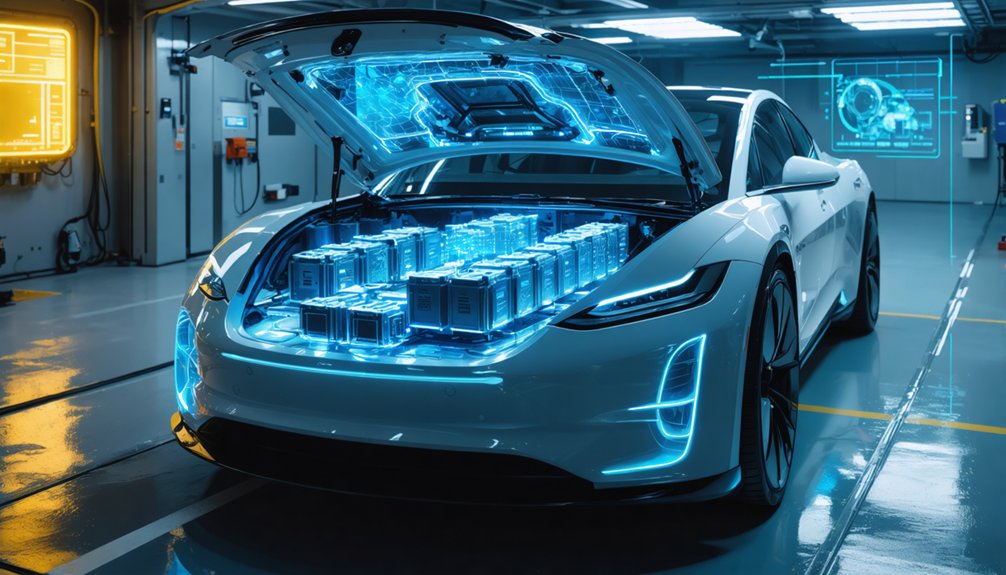

Modern EV batteries last longer thanks to LFP chemistries that sustain 3,000–6,000 cycles and densified NMC that narrows the durability gap while offering higher energy density. Semi‑solid‑state and solid electrolytes suppress dendrites, enabling 8,000–10,000‑cycle lifetimes. Advanced BMS algorithms balance cells, predict remaining useful life, and adjust charging in real time. Optimized fast‑charge protocols taper power after 80 % SOC and manage temperature. Operational practices such as moderate driving, climate‑aware parking, and extended warranties further protect cell health, and the following sections reveal deeper insights.
Key Takeaways
- LFP chemistries deliver 3,000‑6,000 cycles with slower decay than NMC, extending usable years.
- Solid‑state and semi‑solid electrolytes suppress dendrites and enable 8,000‑10,000‑cycle lifespans while improving safety.
- AI‑driven BMS actively balances cells, predicts remaining useful life, and throttles power to curb degradation.
- Adaptive charging protocols taper current near 80 % SOC and keep temperatures within safe limits, reducing fast‑charge stress.
- Fleet operational practices—20‑80 % SOC limits, Level‑2 charging preference, and climate‑controlled storage—preserve battery health.
How New NMC and LFP Chemistries Boost Durability
In recent years, advances in nickel‑manganese‑cobalt (NMC) and lithium‑iron‑phosphate (LFP) chemistries have markedly extended electric‑vehicle battery durability. LFP endurance now routinely reaches 3,000–6,000 cycles, delivering ten‑plus years of service, while NMC densification pushes usable cycles toward the upper 2,000‑range, narrowing the gap with LFP. Independent testing at 0.5 C charge/discharge shows LFP decay rates roughly half those of NMC, preserving discharge capacity longer per cycle. Although NMC offers higher energy density (~250 Wh/kg) and faster charge acceptance, its thermal flashpoint (~210 °C) lags LFP’s safer 500 °C threshold. Cost analysis highlights LFP’s reliance on abundant iron/phosphate versus NMC’s cobalt/nickel demand, reinforcing its appeal for long‑term ownership and community confidence in reliable, affordable EV powertrains. Safety profile of LFP is superior due to its stable chemical structure and resistance to thermal runaway. Lower degradation rates make LFP especially suitable for high‑usage fleets. Extended warranty periods of up to 10 years further support its durability claims.
Why Semi‑Solid‑State Cells Promise Even Longer Life Cycles
The durability gains achieved with NMC and LFP chemistries set a new benchmark, yet the emerging semi‑solid‑state architecture extends cycle life far beyond those limits.
Semi solid electrolytes combine polymer matrices with suspended solid particles, delivering particle stability that resists breakdown over thousands of charge‑discharge events. Lifecycle modeling predicts 8,000–10,000 cycles, a tenfold increase over conventional lithium‑ion, while early prototypes already show minimal capacity loss after 2,000 cycles.
Dendrite suppression further protects the anode, eliminating a primary failure mode and reducing thermal‑runaway risk.
The integrated safety profile permits operation at extreme temperatures without accelerating degradation, enabling manufacturers to promise 300,000–500,000 miles of driving.
This technology cultivates a community of owners who trust longer‑lasting, reliable energy storage. Changan’s “Golden Bell” battery 400 Wh/kg is slated for trial installations before the end of Q3 2026. Adding non‑flammable solid electrolyte further enhances safety and supports higher energy density.
The Role of Advanced BMS Algorithms in Preventing Premature Aging
Through coordinated active balancing, machine‑learning‑driven RUL prediction, and AI‑enhanced state estimation, modern BMS algorithms directly address the mechanisms that accelerate cell wear.
Adaptive balancing redistributes excess charge from high‑SOC cells while discharging low‑SOC cells, using inductor‑based circuits to minimize heat loss and equalize pack voltage quickly.
Predictive throttling, informed by k‑nearest‑neighbors or Random Forest models with R² up to 0.996, limits current or voltage when degradation patterns emerge, preserving cell health.
AI‑driven state estimation continuously refines SoC and SoH by fusing voltage, current, and temperature data, enabling precise range forecasts and timely maintenance alerts.
This integrated approach maintains narrow voltage windows, reduces thermal stress, and extends usable life, fostering a sense of reliability and community among EV owners. first‑generation EVs show the highest replacement rates, underscoring the impact of early‑stage battery management. Adding average‑SOC‑based control further improves balance efficiency. Battery management is recognized as a cornerstone of innovation across the EV ecosystem.
How DC Fast‑Charging Stress Is Mitigated by Optimized Protocols
Across modern EVs, DC fast‑charging stress is curbed by a suite of optimized protocols that synchronize charger output with battery‑management intelligence. A protocol handshake between the charger and the BMS continuously exchanges voltage, current, and temperature data, allowing real‑time adjustments that prevent overload.
Adaptive tapering reduces power once the state‑of‑charge exceeds roughly 80 %, limiting high‑current exposure and mitigating degradation. Integrated temperature‑management systems activate cooling loops to keep the lithium‑ion cells within safe thermal limits during high‑power delivery.
SoC‑optimization protocols keep routine charging between 20 % and 80 % and restrict fast charging at extreme charge levels, preserving capacity. Empirical studies show that these coordinated measures confine fast‑charging‑induced wear to marginal percentages, extending overall battery lifespan. Battery‑buffered chargers help further reduce grid stress while delivering high power to the vehicle.
Real‑World Driving Patterns That Actually Slow Battery Wear
Why do certain everyday driving habits extend battery life? Data from fleet telemetry shows that gentle acceleration and consistent braking reduce energy spikes, keeping the battery’s internal resistance stable.
Moderate driving cuts average consumption by roughly 10 % over the vehicle’s lifecycle, whereas aggressive throttle use can double consumption and accelerate degradation.
Real‑world patterns reveal that mileage alone is a poor predictor; instead, the frequency of smooth acceleration and predictable deceleration correlates with higher state‑of‑health percentages—often 88‑95 % after 100 k mi.
Battery management systems capture these dynamics, allowing algorithms to reward low‑stress cycles. Drivers who adopt steady pacing and avoid abrupt speed changes contribute to a slower annual degradation rate, reinforcing community norms of responsible EV stewardship.
Climate‑Control Tricks That Offset Hot‑Weather Degradation
In hot climates, parking a vehicle in a garage or shaded area can cut ambient temperature exposure, thereby slowing the chemical reactions that accelerate battery degradation.
Garage parking reduces direct solar heating, keeping battery temperature nearer the ideal 20‑25 °C range and preventing the 0.4 % annual capacity loss observed in unshaded exposure.
Complementary climate‑control tricks include preconditioning timing: using grid power while the car is plugged in to cool the cabin and battery before departure, which eliminates thermal stress from hot drives.
Owners are advised to maintain a 20‑80 % state of charge, avoid 100 % charging in heat, and schedule night charging when ambient temperatures are lower.
These disciplined practices collectively curb accelerated aging and foster a sense of shared stewardship among EV communities.
Warranty Terms That Reflect Modern Battery Longevity Expectations
Modern warranty contracts now mirror the proven durability of contemporary EV batteries, typically offering eight years or 100,000 miles—whichever occurs first—and, in many jurisdictions, mandating a minimum of 70 % capacity retention over that span.
Manufacturers such as Tesla, Nissan, and Ford align with this baseline, while Hyundai, Kia, and Toyota extend coverage to ten years or 150,000 miles, reinforcing confidence in long‑term performance.
Warranty transparency is enhanced through clear capacity thresholds and explicit exclusions, allowing owners to assess risk accurately.
These guarantees also serve as resale protection, preserving vehicle value by assuring prospective buyers that battery health remains within contractual limits.
The convergence of extended duration, higher capacity guarantees, and standardized disclosure reflects an industry shift toward reliable, enduring energy storage.
What Fleet Managers Can Do Today to Maximize Battery Investment Returns
By applying a disciplined blend of charging optimization, thermal management, routine maintenance, predictive monitoring, and driver training, fleet managers can safeguard battery health and extract maximum return on their electric‑vehicle investments.
They should adopt fleet protocols that prioritize Level 2 AC as the daily default, limit state‑of‑charge to 20‑80 %, and reserve high‑power DC fast charging for essential trips.
Thermal discipline requires shade parking, ventilation, and preconditioning in cold climates.
Routine maintenance includes annual SoH testing, coolant checks, and OTA software updates.
Predictive monitoring leverages alerts and analytics to flag degradation early.
Driver training reinforces proper plug handling and charging etiquette.
Adequate charge staffing guarantees compliance, documentation, and rapid response to anomalies, protecting investment value.
References
- https://www.recurrentauto.com/research/how-long-do-ev-batteries-last
- https://www.geotab.com/blog/ev-battery-health/
- https://news.stanford.edu/stories/2024/12/existing-ev-batteries-may-last-up-to-40-longer-than-expected
- https://www.caranddriver.com/features/a70112357/electric-car-batteries-how-long-can-they-last/
- https://www.youtube.com/watch?v=ukltk32NNU8
- https://newatlas.com/automotive/ev-study-car-batteries-longevity/
- https://www.electriccarscheme.com/blog/how-reliable-are-electric-cars
- https://www.evlithium.com/Blog/lfp-vs-nmc-batteries-comparison.html
- https://www.electrifying.com/blog/knowledge-hub/lfp-vs-nmc-batteries-what-you-need-to-know-about-electric-car-batteries
- https://www.youtube.com/watch?v=4v892XDMjUs