
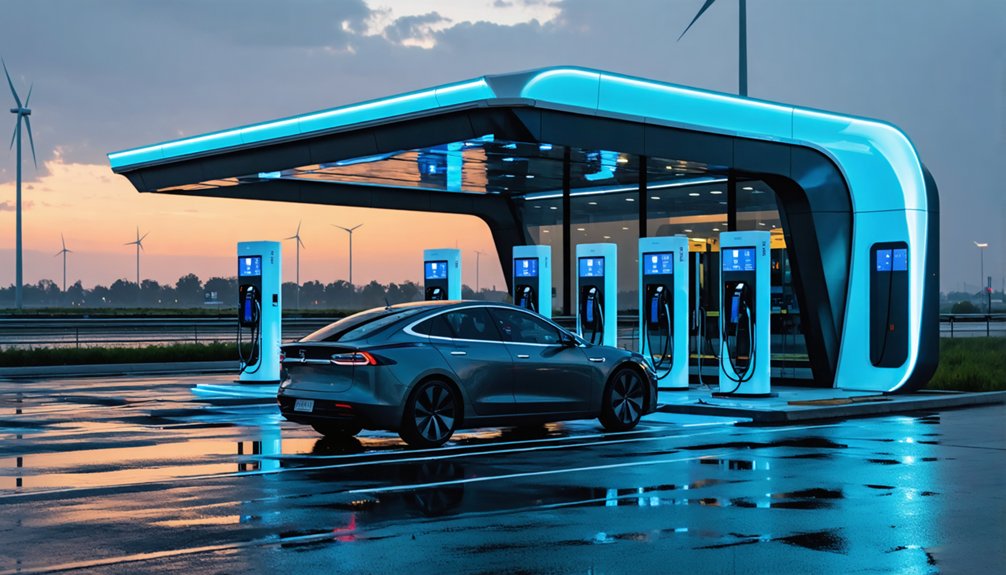

EV charging networks are rapidly reducing range anxiety. In 2025, DC fast‑charging ports grew 30 % YoY, adding 18,000 new stalls and pushing ultra‑rapid 300 kW+ stations onto interstates for 15‑20‑minute top‑ups. NEVI‑backed corridors and private‑sector partnerships now cover rural and low‑income routes, delivering reliable access and high utilization that exceeds break‑even thresholds. Drivers see smoother trips, fewer wait times, and growing confidence that charging is no longer a barrier—further insights await.
Key Takeaways
- Dense corridors of DC fast chargers, with 18,000 new ports in 2025, cut planning horizons and make long‑distance trips feasible.
- Ultra‑rapid 300 kW+ chargers restore 150–200 miles in 15–20 minutes, eliminating “last‑mile” range concerns on highways.
- Dual‑connector stations (CCS + NACS) and interoperable payment systems ensure any EV can access any network, reducing access uncertainty.
- Real‑time availability alerts and subscription models lower wait times and cost surprise, smoothing the charging experience.
- Rural and low‑income corridor investments via NEVI and public‑private partnerships expand coverage, turning range anxiety into a collective, solved issue.
What “Range Anxiety” Really Means for EV Drivers
At its core, “range anxiety” is the fear that an electric vehicle will run out of battery before a driver can reach a charging point, creating a psychological barrier that often outweighs the actual capabilities of modern EVs. Data show the average U.S. driver travels roughly 30‑35 miles daily, while most light‑duty EVs deliver 200‑350 miles per charge, a multiple‑fold safety margin. Yet misconceptions persist, fueled by early low‑range models and insufficient charging literacy. Studies reveal 78 % of owners see anxiety fade after learning routine charging habits, and 59 % of current drivers report no anxiety versus 76 % of prospective buyers. The gap between perceived and real range underscores the need for community education, reinforcing that psychological barriers, not technical limits, dominate the conversation. Modern EV batteries are designed to retain 80‑90 % capacity over many years, meaning long‑term durability is rarely an issue for daily drivers. Driver behavior significantly influences actual range, with smooth acceleration and moderate speeds extending mileage. Peak anxiety occurs among those 1–2 years away from purchasing their first EV.
How Fast‑Charging Port Growth Has Changed the Landscape (2024‑2025)
Accelerating the rollout of DC fast‑charging ports has reshaped the U.S. landscape, delivering nearly 18,000 new ports in 2025—a 30 % year‑over‑year surge that eclipses prior forecasts.
Station clustering intensified, with operators opening sites housing eight to twelve or more ports, creating dense hubs that cut wait times and foster shared amenities.
Port redundancy rose as multiple connectors per station mitigated single‑point failures, while over half of Q4 installations offered 250 kW+ power, slashing charge cycles for compatible EVs.
Temporarily Unavailable Stations continued building fast chargers despite the federal funding pause. Long‑term industry confidence remains strong.
Non‑Tesla networks—ChargePoint, EV Connect, IONNA—expanded aggressively, and NACS adoption doubled, broadening vehicle compatibility.
Together, these trends underpin a more reliable, community‑focused charging fabric that eases range anxiety for drivers nationwide.
NEVI and Private‑Sector Initiatives – Building Reliable Corridors
By leveraging the newly released $5 billion federal pool, the NEVI program now coordinates a synchronized effort with private‑sector partners to stitch together high‑speed charging corridors that can sustain long‑distance travel.
Policy flexibility introduced in August 2025 allows states to prioritize rural routes, secondary highways, and MDHD hubs, replacing the former 50‑mile spacing rule.
Public‑private partnerships flourish as Electrify America, GM/EVgo, and Flying J expand non‑proprietary, open‑access stations that meet the four‑150 kW DC Fast Charger minimum.
Automakers such as Stellantis and Volkswagen adopt NACS plugs, further unifying the network.
Together, federal, state, and private investments create reliable corridors, reinforcing a shared vision of seamless, nationwide EV mobility.
The program’s dual‑connector mandate now requires all new stations to support both CCS Type 1 and NACS, enhancing cross‑brand compatibility.
State‑specific funding is allocated based on each state’s FHWA funding formula under 23 U.S. Code 104.Rapid‑track approvals have cut project timelines, allowing many stations to be built within months of funding.
Utilization Rates That Exceed Break‑Even – Why It Matters Now
A surge of activity now pushes utilization rates well beyond the 15‑20 % break‑even threshold that traditionally defines a viable fast‑charging station, with ChargePoint’s network reporting 80 % utilization in both San Francisco and Los Angeles.
The data reveals that session volume grew 34 % in 2025 while new ports expanded only 16 %, creating network congestion that pressures utilization thresholds upward.
Over 100 million sessions and 190 000 added ports underscore a market where demand outpaces infrastructure, signaling accelerated ROI for investors and reassuring drivers that fast‑charging is becoming a reliable daily amenity.
This surge not only validates the business model but also fosters a sense of community among the growing million‑plus EV user base. Nearly 60 % of the 19.3 billion electric miles enabled by ChargePoint occurred over the most recent two years.
Ultra‑Rapid Chargers on Highways – 15‑20 Minute Top‑Ups Explained
Deploying 300 kW+ ultra‑rapid chargers along major interstate corridors is reshaping long‑distance EV travel, delivering 15‑20 minute top‑ups that restore 150–200 miles of range on compatible vehicles.
In 2026, North America added over 17,500 DC fast ports, with monthly installations exceeding 1,000, creating a dense network of high‑power stations.
These chargers rely on advanced battery thermal management to sustain 300‑350 kW rates without overheating, ensuring reliability for drivers.
Highway amenities such as weather‑protected canopies, digital signage, and nearby retail reinforce a sense of community, making stops feel like extensions of the journey rather than interruptions.
The rapid‑charge model addresses range anxiety directly, offering a predictable, short‑duration recharge that aligns with the expectations of long‑distance travelers.
Real‑World User Data – 34% Session Growth vs. 16% New Port Growth
Although the number of charging ports rose by only 16 % in 2025, total charging sessions surged 34 %, indicating that existing infrastructure is being used far more intensively than it is expanding.
The data reveal a shift in usage patterns: fast‑charging stations in major markets consistently operate at 80 % utilization, far exceeding the 15‑20 % break‑even threshold. Session density has risen because drivers are clustering around high‑capacity hubs, where average stalls per DC station grew from 4.1 to 4.7.
New ports still matter—190,000 additions and a monthly influx of roughly 36 stalls—but the surge in sessions shows community confidence in the network’s reliability.
This intensification suggests that EV owners feel increasingly integrated into a shared charging ecosystem, easing range‑anxiety concerns.
Rural and Low‑Income Deployments – Closing the Gap in Underserved Areas
Across the United States, the NEVI program is reshaping the charging landscape by channeling federal resources into rural corridors and low‑income neighborhoods that have long been overlooked. By allocating billions to state transportation departments, the initiative mandates high‑speed, interoperable stations and upfront uptime standards, compelling states to prioritize underserved counties.
Community outreach drives local input, while charging cooperatives enable shared ownership, reducing private‑sector risk and fostering trust. Early 2025 data show 45 % of rural counties now host at least one fast port, a notable rise from previous years, yet utilization remains in the teens.
Targeted grid upgrades and flexible site selection aim to close the “charging desert” gap, ensuring equity and expanding the sense of belonging for drivers across America.
What Drivers Should Expect in 2026 and Beyond? The End of Range Anxiety?
How will drivers experience electric mobility in 2026 and beyond, now that the nation’s charging network is expanding at an unprecedented pace?
With public DC fast‑charging ports surpassing 70,000 and an anticipated 80,000 stalls by year‑end, drivers will encounter dense, reliable corridors that shrink planning horizons. NEVI‑mandated uptime and interoperable payment systems foster confidence, while subscription models from operators such as ChargePoint and Electrify America smooth cost expectations and guarantee access during peak demand.
Emerging charging etiquette—brief plug‑in intervals, courteous stall sharing, and real‑time availability alerts—reinforces community norms and reduces wait times.
As utilization climbs beyond historic 15‑20 % benchmarks, the network’s redundancy and standardized protocols collectively signal a decisive move toward the end of range anxiety.
References
- https://marksparksolutions.com/reports/us-electric-vehicle-charging-station-market
- https://www.eenews.net/articles/the-american-ev-charging-network-is-booming-report-finds/
- https://www.greencars.com/news/charging-demand-is-growing-even-while-ev-headlines-turn-cautious
- https://acd-inc.com/blog/key-ev-charging-trends-predictions-for-2026/
- https://electrek.co/2026/02/11/chargepoint-data-shows-a-new-ev-bottleneck-forming/
- https://driveelectric.gov/stations-growth
- https://www.kbb.com/car-news/report-ev-charging-demand-outpacing-network-growth/
- https://www.ezevelectric.com/ev-charging-industry-predictions-and-trends-2026/
- https://ampereev.com/is-range-anxiety-still-a-barrier-for-ev-adoption/
- https://www.geotab.com/blog/range-anxiety/